Planning guidance, not a site specification. Final capacity, utilities and installation depend on the selected equipment and location.
SITE-SPECIFIC PLANNING
PLANNING INPUTS4questions that determine fit
OPERATING TOPICS6from demand to service
STARTING SYSTEMS5options to evaluate
DECISION STATUSREVIEWsite confirmation required
THE OPERATING MODEL
Design for the busiest minutes—not the average day.
Daily volume sets the scale. The peak reveals the workflow. Read both beside the menu, operator, utilities and service plan before choosing a platform.
ILLUSTRATIVE DEMAND PROFILEExample only · not a site forecast
OPENPEAKMIDDAYCLOSE
INPUT 01Which menu and service standards must be consistent?
INPUT 02What demand tiers exist across locations?
INPUT 03Can every site support the selected utilities and telemetry?
INPUT 04Who approves substitutions, training and local service?
THE FIELD GUIDE
Six decisions that shape a workable system.
Each chapter focuses on a decision that changes machine fit. Read the opening point, then unfold the detail when it matters.
01
Start with a shared operating brief
A multi-site program needs a definition of the experience before it needs a model number. Set the intended menu, cup sizes, service style and daily cleaning responsibilities.
Continue the field note
Identify what should remain consistent and what may vary by location. A compact site, a flagship and a transport-adjacent outlet can have very different demand patterns. Gather those differences early so a shared purchasing decision does not hide local capacity or installation problems.
02
Build demand tiers from evidence
Measure typical daily drinks, the busiest day and the busiest fifteen-minute period at representative sites. Include drink mix and staffing.
Continue the field note
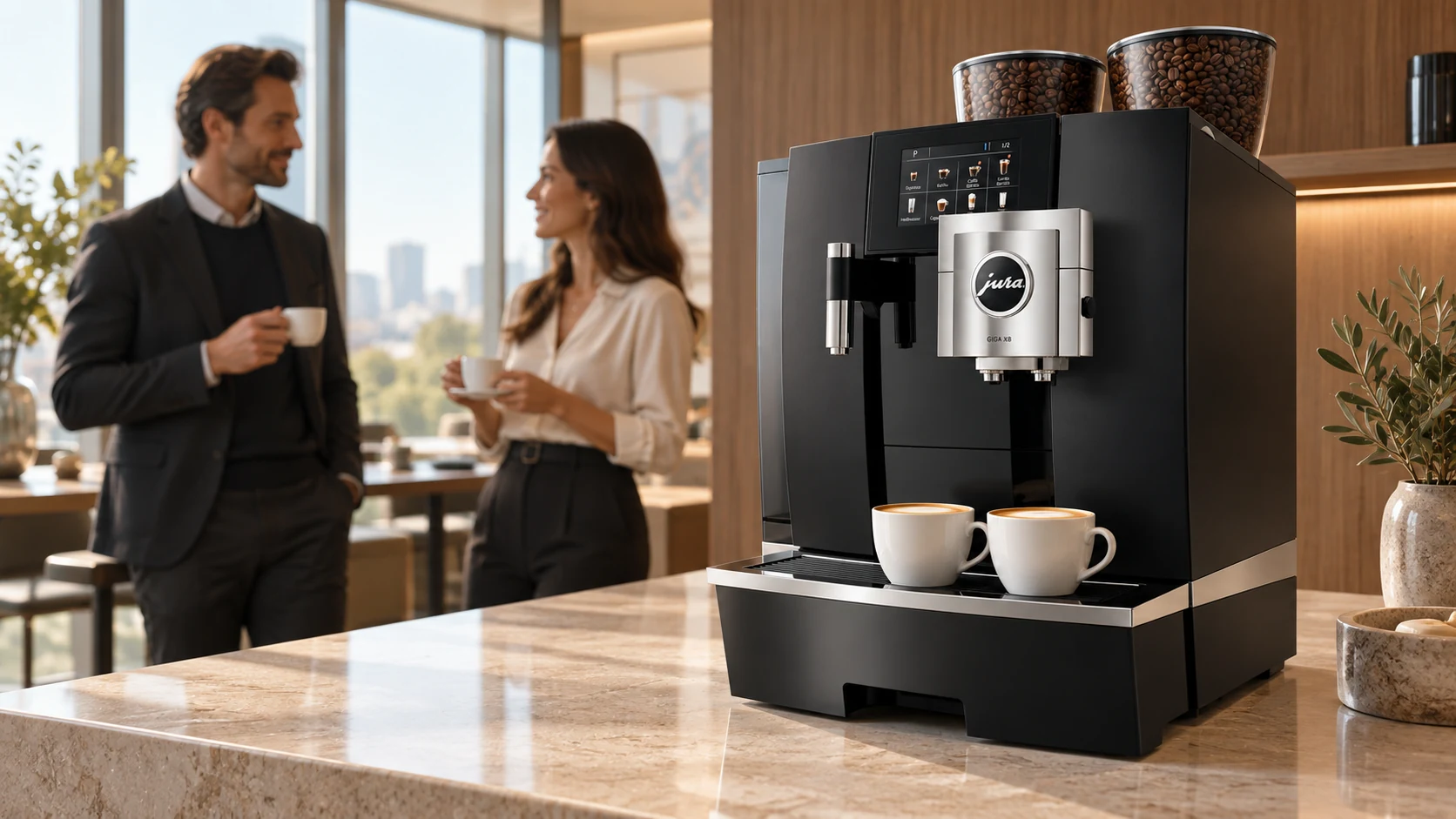
Use verified machine ratings to screen known limits, then assess peak workflow separately. For example, the W8 and GIGA X8 have different daily recommendations, while larger Eversys families publish drink-specific laboratory rates that require configuration and workflow review. A tier should describe the operation it serves, with an explicit path when demand exceeds the verified range.
03
Lock the exact configuration
A family name alone may leave the generation, milk system, grinder arrangement or electrical version unresolved. Record article numbers, selected options and accessory part numbers in the approved specification.
Continue the field note
Keep bundle contents visible so sites do not receive duplicate milk equipment or incompatible water kits. If the supplier changes a generation or substitute part, review the effect on recipes, maintenance and installation. Current manufacturer information should be tied to the equipment actually being ordered.
04
Review every site before shipping
Use a consistent readiness checklist for voltage, circuit, receptacle, water supply, drainage, water quality and counter clearances. Ask for the local service arrangement and any access restrictions.
Continue the field note
A standard model may still need different electrical or treatment work at different addresses. Schedule authorized installation where required and identify who confirms readiness. The goal is a repeatable process with documented local checks, rather than an assumption that one successful installation guarantees every subsequent location will be identical.
05
Make training and support repeatable
Provide opening, closing and cleaning instructions matched to the approved configuration. Decide how recipes and settings are controlled, who trains new staff and where support requests go.
Continue the field note
For Eversys, review telemetry availability and the associated warranty conditions across the estate. Compare manufacturer coverage with dealer labor and response agreements. Define how consumables are ordered and how equipment is handled during downtime, so the operating standard remains practical after the initial launch team has left.
06
Pilot before expanding the estate
Use a representative pilot to observe queues, drink consistency, cleaning effort and refill frequency. Gather operator feedback and actual service data before committing to a wider rollout.
Continue the field note
The machines below are platform candidates for a program; they are not automatically suitable for every franchise format. Once the pilot confirms the workflow, document the approved station cost and unresolved local expenses. Revisit the specification as demand changes, while preserving a clear history of generations, accessories and installation requirements.
SITE READINESS
The machine is one line in the site plan.
Confirm what surrounds it before cabinetry, utilities or purchasing are finalized.
01
Create exact model and accessory specifications.
02
Validate demand tiers with a representative pilot.
03
Require site-by-site utilities and service checks.
04
Separate manufacturer warranty from local service commitments.
Tri-state commercial installation is available upon request, subject to site, machine and service-area confirmation.
These model families are reasonable planning candidates for this setting—not a site-specific recommendation or capacity guarantee. Confirm demand, workflow, configuration and installation before ordering.
Build a coffee program around the people using it, the busiest part of their day and the teams keeping it running.
YOUR OPERATING BRIEF
Use actual drink demand—not employee count. For more than 2,000 drinks per site daily, speak with a specialist.
Peak planning equivalent120drinks / hour
Your 15-minute demand × 4. This expresses the intensity of the rush; it does not predict machine output.
Across your locations200drinks / day
Assumes the same stated daily demand at each location. Model each site separately when routines differ.
A workflow people can use.
Choose employee self-service, staffed preparation or barista service. Confirm automatic versus manual milk preparation.
Ready for your facilities team.
Confirm electrical supply, treated water, drainage, counter clearances, milk cooling and service access before specifying equipment.
A coffee program with an owner.
Assign daily cleaning and replenishment. Agree on installation, local service, warranty coverage and repair arrangements for every site.
Plan the busiest fifteen minutes.
Daily ratings and lab output do not guarantee sustained mixed-drink service. A specialist should verify capacity and configuration before a commercial order.
Tri-state commercial installation available upon request. Site, service-area, utilities and scope require confirmation. Warranty terms do not establish a repair response time or uptime guarantee.
MAKE IT YOUR DAILY COFFEE
What does your coffee routine cost?
Adjust your daily cups and costs to compare buying coffee with the first year of owning a machine. The estimate updates as you go.
1 cups200 cups
$1$12
$0.1$4
$0$3000
ILLUSTRATIVE FIRST YEAR / 260 COFFEE DAYS
$39,781lower modeled first-year cost
Purchased coffee$52,000
Machine + ingredients + care$12,219
Equipment
$3,299
Modeled cups
10,400
Ownership inputs
$8,920 / yr
Excludes tax, shipping, installation, financing, energy, labor, repairs, downtime and resale. It does not assess capacity or guarantee savings.
Guided matching by drinks, volume, workflow, space and budget
Confirm the exact model, variant, stock and order price
Technical planning
Compare dimensions, listed output, care and known trade-offs
Confirm installation drawings, utilities and local service conditions
Compatible setup
Surface model-linked care and service accessories
Verify final compatibility and quantities before payment
Warranty
Show model-specific published terms and material conditions
Confirm purchase eligibility and written terms for the exact order
Commercial installation
Frame the water, power, workflow and service questions
Quote availability and scope after a tri-state site review
This checklist is not a claim that any named retailer lacks a service. It separates editorial guidance from facts that can only be finalized for the selected order, location and intended use.
Franchises & multi-site teams coffee solutions | CoffeeDepot